Take actionSeptember 22, 2026
🍋 What your parent can no longer decide, you still can
The years of decision your parent no longer has, you still have: three often-neglected tests, daily movement, a routine rather than a goal.
Read the guide
Planning ahead means writing down the medications, the doctor, the allergies and the people to call now, before an emergency forces the issue.
Yvan Keyna · Published on September 2, 2026
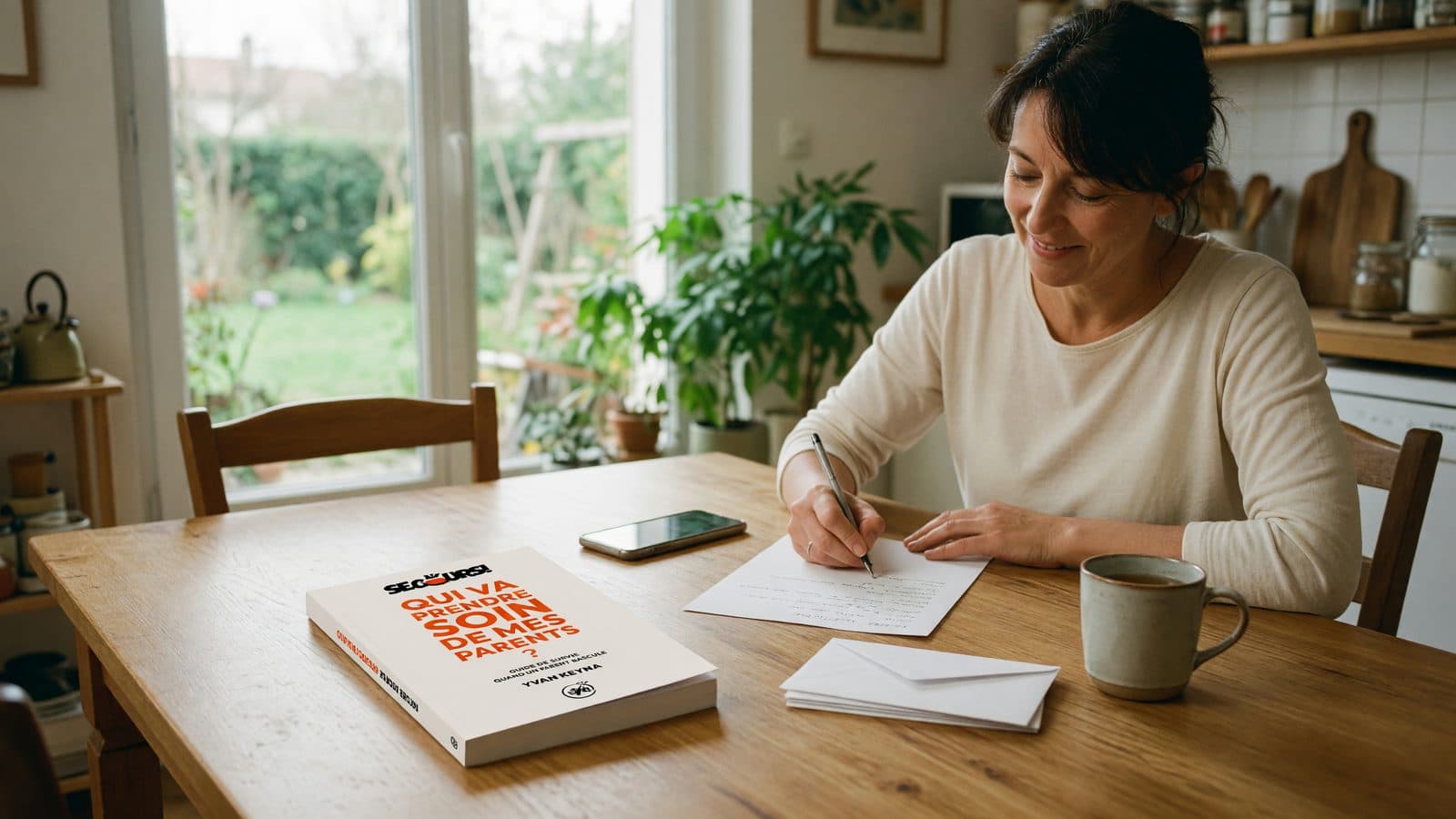
A review of twenty-two studies measured it: when an older person arrives at the hospital, the list of their medications contains an error in up to 67% of cases. 👉 the review of twenty-two studies Most often, what is missing is a medication taken at home that no one had written down anywhere else.
Planning ahead does not mean guessing the future. It means writing down, while everything is still fine, what is already known: the current medications, the doctor's name, known allergies, who to call, what the person likes and refuses. A page kept up to date fills in what, on the day of an emergency, takes time to track down.
What this article does not do: it offers no legal document, recommends no administrative procedure, and never says who should decide on someone else's behalf. It describes what can be prepared at home, with no third party involved — and it does not claim this prevents an accident, an illness or an emergency. It only prepares you to respond faster, with less to search for.

Question 1
Nothing in a day that goes well prompts anyone to write a page about what could go wrong. This is not negligence. No moment ever comes along on its own to do it, and the idea of bringing it up feels, wrongly, like bad news you would be delivering yourself.
You see it even where the stakes are most visible. A review of twenty-six studies asked people nearing the end of life about this conversation: 61 to 91% of them said they wanted to have it, and only 2 to 29% had actually had it with a professional. 👉 the review of twenty-six studies
The reasons given in these studies point to no one's fault. The one cited most often: family members who hold back, not out of indifference, but to protect the person they love from a painful discussion. Next comes the idea that it will be handled "when the time comes" — a time that, by definition, never comes on its own. The same logic applies to a parent who is doing well today: nothing signals the day when writing the page would have helped, until that day has passed.
Question 2
An emergency team in a hospital department timed how long it took to learn the basics about an arriving person aged 75 or older: their medications, their medical conditions, their allergies, their doctor. Of the 104 people followed, only one in six had all of it in mind or on hand. 👉 the study conducted in an emergency department
What was missing most often: current medications in one case out of five, known medical conditions and the primary care doctor's contact information each in one case out of ten, allergies in one case out of twelve. For a quarter of the people, the record stayed incomplete — not for lack of effort, but because the information simply was not available that day.
Among its recommendations, the World Health Organization sets out the reverse procedure: rebuilding this list from several sources — the person or their family, an up-to-date list or card, a check of the boxes brought in, the doctor, the pharmacist. 👉 the WHO High 5s protocol In other words, everything a family can prepare at home is exactly what an emergency department is looking for that day. Taking photos of the medication boxes, or keeping an up-to-date list, is named as a practical suggestion by that same organization — a five-minute step, not a procedure. 👉 the WHO document on medication safety
Question 3
There is a sentence you sometimes start: "What if one day you can't...". It comes out halfway, then trails off in front of a face that closes before you even finish. You change the subject. You feel like a coward — and at the same time, a little relieved that you did not push.
An international consensus of more than one hundred specialists, brought together on this exact subject, set out three points that are useful here. One: this conversation can start at any age and in any state of health — not only after a diagnosis. Two: it can take place at home just as well as in a medical setting. Three: it is better to come back to it several times than to get it right in one go. 👉 the international consensus of specialists
The same work names the two pitfalls: starting too early creates reluctance, and starting in the middle of a crisis comes after the useful moment. In between, there is a wide window — and a parent who is doing well today is right in it.
What gets put off this way is not a conversation about the end of life. It is a smaller conversation, about what is already known and never written down. Yvan Keyna makes it a rule in his book Help! Who's Going to Take Care of My Parents? — plan ahead, plan ahead, plan ahead: not a subject you settle once and for all, but an idea you return to, again and again. 👉 Help! Who's Going to Take Care of My Parents?
Some people start somewhere else, with a shared moment rather than a serious question — that is the spirit of the book Let's Remember Together. 👉 Let's Remember Together
Question 4
A single page is enough to hold what was missing most often in the studies cited above: current medications and their doses, known allergies, the doctor's name, daily habits, what the person likes and what they refuse. A photo of the medication boxes, taken on a calm day, completes this page with little effort.
An honest clarification belongs here, and it matters more than the rest: what has legal force varies from one country to another — that is not the subject here. What follows applies everywhere: what you know, and what you have written down.
One comparison, for example, looked at the written rules of twenty-eight countries on wishes recorded in advance: only slightly more than half have a specific rule, and no two are alike. 👉 the comparison of rules in twenty-eight countries This is neither a delay nor a failing on anyone's part. It is a framework that differs, and it stays outside the subject of this page.
The page itself needs no legal form to be useful. It serves on the day someone has to answer a simple question quickly — and a copy, left with a second person, keeps it from being lost along with the first. This is what the book Help! Who's Going to Take Care of My Parents? develops more broadly, through what it calls an action plan for dealing with the unexpected. 👉 Help! Who's Going to Take Care of My Parents?
Question 5
In an audit of one hundred hospitalized people aged 75 or older, for those who had difficulty giving their own history, a history completed by a family member existed in slightly fewer than half of cases. When it existed, it came from a son or daughter two times out of three, and from a spouse one time out of six. 👉 the audit of one hundred hospitalized people
The most useful detail from this audit fits in one sentence: four times out of five, this information was gathered in the very first hours — or never. There is almost no second chance.
No study says in what order to call people, or who should keep a spare set of keys. These are common-sense steps, not research findings. What is established, however: the family remains the first source of information named by hospital protocols, and choosing a trusted person in advance is part of what several international consensus statements on the subject recommend together. 👉 the international consensus statements on the trusted person
Writing down this chain — who calls whom, in what order, who has a spare set of keys — takes no research and no complicated decision. This is the idea the book Help! Who's Going to Take Care of My Parents? develops when it asks who is involved, and who calls whom. 👉 Help! Who's Going to Take Care of My Parents?
Question 6
A World Health Organization recommendation advises, for a person at risk of falling and after an assessment by a trained professional, identifying and correcting the hazards in their home. 👉 the WHO recommendation on falls This is an assessment, not a quick look — and in most countries, you pay for it.
What this assessment looks at, on the other hand, is public, and nothing stops you from starting by looking at it yourself: the lighting, loose rugs, stairs, clutter on the floor, the entryway, the bathroom, the kitchen, the lack of a bar to hold on to. 👉 the Step Safely guide A Cochrane review brought together twenty-two studies conducted in ten countries on this same type of home intervention, covering more than eight thousand people aged 65 or older — and it focuses precisely on what such an assessment looks at. That is all that can honestly be said about it here. 👉 the Cochrane review on home modifications
Two steps then go side by side, and neither rules out the other: looking yourself at the points this recommendation lists, and bringing in someone trained for an opinion. The first does not replace the second — it prepares for it. The second has a real cost in most countries, and that should be said plainly.
Question 7
Nothing above requires an appointment. Seven steps, each with its real cost, can be done in whatever order suits you — or in no order at all.
Take photos of the medication boxes and current prescriptions: free, five minutes. Write a single page — medications, doctor, allergies, contacts, habits, what is liked and what is refused: free, about forty minutes. Leave a copy with a second person, not only at your own home: free.
Write down the call chain — who calls whom, in what order, who has the keys: free. Look over the home, room by room, using the points an international recommendation lists: free to observe — the modifications themselves cost money, sometimes a lot, and that should be said plainly. Bring in a home-safety professional for a trained opinion: paid, in most countries.
Go back over this page, for example once a year — that is a suggested schedule, not an established rule. What is established is reviewing it with every change in health or daily life, and with every new medication. 👉 the WHO document on medication review A page several years old no longer says much about the person it describes.
None of these steps promises to prevent anything. They promise only that one day, if everything changes, the information will not be missing — because it will already have been written down, on a quiet weekend, long before.

Author: Yvan Keyna
| # | Fact cited | Link |
|---|---|---|
| 1 | Review of 22 studies (CMAJ, 2005): up to 67% of medication histories contain an error at admission, most often an omitted medication | the review of twenty-two studies |
| 2 | Review of 26 studies (BJGP, 2013), people nearing the end of life: 61-91% want the conversation, 2-29% have had it; family reluctance out of tact | the review of twenty-six studies |
| 3 | Study conducted in an emergency department, 104 people aged 75 or older: 15.4% had all the information on them; what was missing most (medications, medical conditions, doctor, allergies) | the study conducted in an emergency department |
| 4 | WHO High 5s protocol (9 countries): sources for rebuilding the medication history — the person or their family, their list, their boxes, the doctor, the pharmacist | the WHO High 5s protocol |
| 5 | WHO, Medication Safety in Transitions of Care (2019): discrepancies affect almost everyone who moves between care settings; photographing the list or the boxes, a practical suggestion | the WHO document on medication safety |
| 6 | EAPC international consensus (109 experts, 14 countries), Lancet Oncology 2017: the conversation at any age, in or outside a care setting, to be revisited over time | the international consensus of specialists |
| 7 | Comparison of the written rules of 28 countries on wishes recorded in advance: slightly more than half have a specific one, no two are alike | the comparison of rules in twenty-eight countries |
| 8 | Delphi panel of 52 experts (4 countries), JPSM 2017: choosing a trusted person, revisiting as health or life changes | the international consensus statements on the trusted person |
| 9 | Audit (conference, Age and Ageing 2019), 100 hospitalized people: history completed by a family member in ~44% of cases of cognitive difficulty, a son or daughter in 66% of cases, gathered at admission or never in 80% of cases | the audit of one hundred hospitalized people |
| 10 | WHO ICOPE (2017), recommendation 11: home modification after assessment by a trained professional, for people at risk of falling | the WHO recommendation on falls |
| 11 | WHO, Step Safely (2021): points checked in a home — lighting, rugs, stairs, bathroom, kitchen, entryway, clutter, grab bars | the Step Safely guide |
| 12 | Cochrane review (2023), 22 studies, 10 countries, 8,463 people aged 65 or older: existence and subject of the review, cited without its result | the Cochrane review on home modifications |
| 13 | WHO, Medication Safety in Polypharmacy (2019): the medication list is reviewed with every new medication and every change of care setting | the WHO document on medication review |
| 14 | The book Help! Who's Going to Take Care of My Parents? — planning ahead, an action plan for the unexpected, who calls whom | Help! Who's Going to Take Care of My Parents? |
| 15 | The book Let's Remember Together — mentioned once, with no description and no promise of effect, to support the idea of opening the conversation through a shared moment | Let's Remember Together |
Current medications and their doses, known allergies, the doctor's name, daily habits, what the person likes and what they refuse. A photo of the medication boxes completes the page in five minutes.
In the person's home, in a known place, with a copy at someone else's home. A single copy disappears with the home on the day you need to find it.
With every change in health, in daily life or in medications. A review once a year is a suggested schedule, not an established rule: what matters is that it still describes the person as they are today.
The years of decision your parent no longer has, you still have: three often-neglected tests, daily movement, a routine rather than a goal.
Read the guideA consumer artificial intelligence tool can translate a medical document into plain words and help you prepare your questions, without replacing professional advice.
Read the guideExercise and diet alone do not prepare you for aging: the real training happens alongside people who have already grown old.
Read the guide
Leave your email: the next game comes to you, no need to look for the QR code.