Why is it almost always the same person who calls the doctor, handles the paperwork and keeps the family informed? This imbalance has known causes — and a simple way to make it visible, before it turns into blame.
The answer fits in one sentence: a written plan, task by task, agreed on with your siblings rather than put up with in silence. Several international studies show that one person becomes the main point person first, rarely because the others are unwilling, but because no one ever named who does what. Naming each task changes what everyone sees.
What this article does not do: it does not say who, in your family, is right or wrong. It gives no legal advice, and it does not guarantee that your siblings will accept the proposal the first time. It explains a known, documented mechanism and offers a method to make it visible — nothing more.

Question 1
It isn't: in the vast majority of families, helping a parent is not split equally between brothers and sisters. It is not a personality trait: international studies, carried out over several years, show that distance, availability and the lack of any clear designation decide, in silence, who becomes the main point person.
A seven-year follow-up study measured it precisely: about three out of four parents helped by their children are helped first by one child. 👉 the seven-year follow-up study The other siblings did not decide to step back — at no point did anyone designate who would do what.
A prospective study, which followed 537 adult children for seven years, measured what predicts who becomes that point person: living less than two hours away by car multiplies the odds by six, being a daughter multiplies them by a little more than two, and having been chosen in advance by the parent multiplies them by three. 👉 the prospective study of 537 adult children
None of this is written down as a rule. It is geography, availability and expectation, which took hold without ever being discussed.
An analysis covering 14 European countries confirms the weight of gender: three out of four children who help a parent every week are daughters, and that share changes from one country to another — it is not a law of nature, it is also a matter of context. 👉 the analysis of 14 European countries This is what the book Help! Who's Going to Take Care of My Parents? explores — 👉 Help! Who's Going to Take Care of My Parents?
Question 2
“Taking care” of a parent covers very concrete tasks: booking appointments, managing medications, doing the grocery shopping, handling the paperwork, sometimes spending nights on watch. And on top of all that, there is coordination — connecting each task to the next. That is what weighs the most, and what shows the least.
A study of 1,739 family members helping 1,171 older people measured this coordination: nine out of ten booked the appointments, more than eight out of ten ordered the medications. 👉 the study of 1,739 family caregivers
Booking an appointment, renewing a prescription, calling back a doctor who didn't answer: it looks like nothing. It is a category of work that researchers measure separately, because it counts.
Making a list of these tasks, one by one, is the first step before talking to your siblings. As long as they stay grouped under a vague word — “taking care,” “helping” — they don't get shared. They stay entirely on one person, the one who took them on first.
Question 3
What you do for your parent can't be seen from far away — not because your siblings don't care, but because a good part of this work leaves no visible trace. Coordinating, anticipating, worrying: these are tasks with no schedule, no invoice and no witness.
An analysis that reviewed 25 studies conducted in several countries gave a name to that part: the hidden costs of helping a parent — time, missed opportunities, relationships put on hold. The authors themselves call them invisible, even to the people who carry them. 👉 the analysis of the hidden costs of helping
Maybe someone has already said to you: “Just tell me what you need.” And you didn't know what to answer — because what you do doesn't fit in one sentence, and no one else sees the details. That can leave a simple feeling: being alone, and a little angry about it.
It is neither ill will nor willful blindness. A qualitative study, conducted with a small number of families in the middle of a disagreement, showed that the dispute is rarely about “who does the most” — it is about the feeling that one person decides alone, or keeps the others out. 👉 the qualitative study of family disagreements
As long as what gets done is not named, it stays invisible. And what is invisible can't be shared.
Question 4
The day a decision has to be made fast — a hospital stay, a change in condition, a choice to settle within the hour — is never the right time to find out that no one has thought about this question. It gets settled ahead of time, calmly, not in an emergency.
Three simple questions are enough to raise it with your siblings, on a calm day: who is told first, who speaks to the doctor on behalf of the family, and who has the final say if the disagreement continues. None of these answers needs a legal document to exist — one conversation, held once, is enough for everyone to know where they stand.
This is what the book Help! Who's Going to Take Care of My Parents? explores — 👉 Help! Who's Going to Take Care of My Parents?. Assigning this role before it imposes itself changes what happens on the day a real decision has to be made.
Question 5
Living far away doesn't mean helping less — it means helping differently. A review that brought together 16 studies on family members who help from a distance concludes that they make a real contribution: material, financial and social, not just an occasional presence. 👉 the review on helping from a distance
What they lack most, according to the same review, is not willingness: it is accurate information about what the parent really needs, day to day. Distance makes communication harder first, before it makes the help itself harder.
Contributing money, when you can't contribute time, is one of the forms that helping from a distance takes — it costs something, and saying so openly is better than letting others believe it doesn't count. A regular call, on a set day rather than whenever worry strikes, gives the one who is far away up-to-date information, and gives the one who is nearby a named backup.
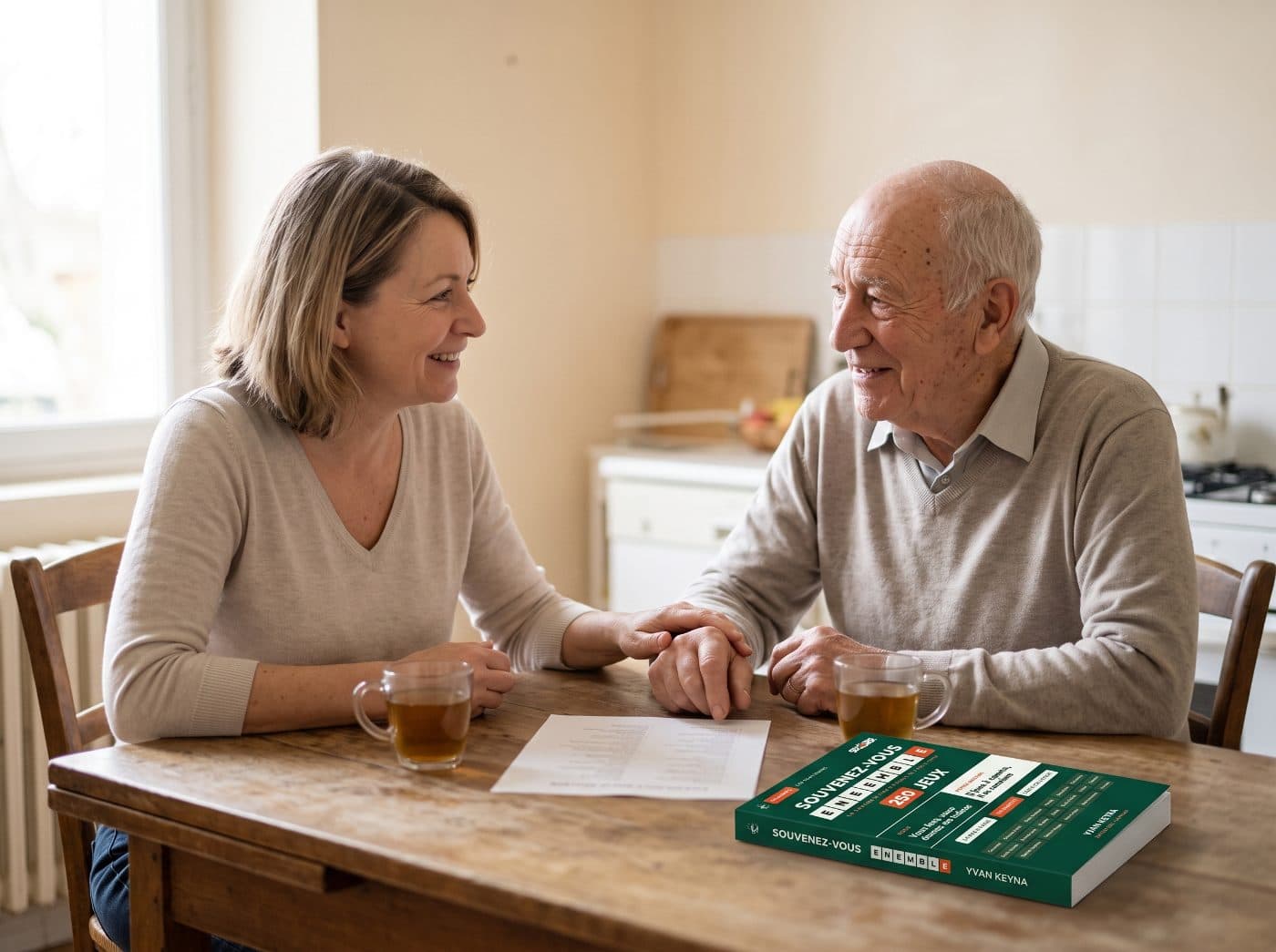
The visit, when it finally happens, doesn't have to be filled only with overdue paperwork. In his book Let's Remember Together, Yvan Keyna offers 250 games to play together with an aging parent — a way to spend that time differently than catching up on paperwork. 👉 Let's Remember Together
Question 6
A plan that works doesn't stay frozen in time, and that is not a flaw: it shifts because the parent's needs shift. The same seven-year follow-up study mentioned above observed this directly.
When the parent's needs increase, other children step in to help, and the hours are shared more equally. 👉 the seven-year follow-up study A plan doesn't break when it no longer fits the situation — it gets revised, and that is exactly why it holds.
A European study, which compares brothers and sisters with each other rather than families with each other, sees the same thing over time: the one with the most available time does more, and geographic proximity remains decisive in how help is organized between them, year after year. 👉 the European study of siblings
Reviewing the plan on a set date, rather than in reaction to a crisis, avoids the most common mistake: waiting for the situation to force a change, instead of deciding it together. In his book Help! Who's Going to Take Care of My Parents?, Yvan Keyna devotes entire chapters to what plays out between brothers and sisters — who is involved, who decides, and the mistakes to avoid. 👉 Help! Who's Going to Take Care of My Parents?
Question 7
Even well prepared, the conversation can go badly. What is still possible, in that case, comes down to a few specific steps — and it is better to know what they really cost before suggesting them, rather than finding out along the way.
Writing down the list of real tasks — appointments, calls, paperwork, errands, nights, coordination — costs nothing but an hour in front of a sheet of paper. It is the foundation for everything that follows: without it, there is nothing to share, only an impression to argue about.
Assigning each task, rather than asking someone to “help,” costs nothing either: it means putting a name next to each line, not sharing out a worry. One name per line makes visible who already does what, and what is left with no one.
Setting a check-in between brothers and sisters, short and on a regular date, costs nothing — and keeps the plan from being revised only in a crisis. Ten minutes, once a month, is enough to say what has changed and what needs to shift.
Contributing money, when you live far away and don't have the time, really costs something — and saying so openly is better than letting one sibling believe the other does nothing. It is not buying your way out of being there, it is another way of carrying your share.
Deciding in advance who speaks to the doctor and who makes quick decisions costs nothing either, except a difficult conversation, to have once, before you need it. On the day a real decision has to be made, no one then has to improvise a role that no one agreed to.
When none of this is enough to ease the tension, there is one last step: a neutral third party, trained in family disagreements — called a family mediator. According to the code of ethics of an international network of mediators, the mediator decides nothing for the family: they help everyone talk to each other, and everyone stays free to stop whenever they want. 👉 the code of ethics for family mediators
This third party exists, under this name or another, in several countries — and it is not free. Using one doesn't stop anyone, afterward, from continuing to decide for themselves.
Bringing the whole family around a table has also been tested, in a randomized trial, for family members helping a parent with a memory disorder. 👉 the trial on family meetings Fewer than half of the families randomly assigned to these meetings completed the one-year protocol.
Family resistance and conflicts already in place are among the reasons given. That is an argument for getting organized before the disagreement is there — not a promise that the meeting, once the conflict has set in, will be enough to defuse it.
None of these steps guarantees that the discussion will go well. But none of them is reserved for a family that already knows how to go about it.
Sources used (14)
| # |
Fact cited |
Link |
| 1 |
Seven-year follow-up study (2020): about 3 out of 4 parents helped by their children are helped first by one child; more equal sharing when needs increase |
the seven-year follow-up study |
| 2 |
Prospective study (2014, 537 adult children): distance (x6), gender (x2), advance designation by the parent (x3) predict who becomes the point person |
the prospective study of 537 adult children |
| 3 |
Analysis of 14 European countries (2012): 3 out of 4 children who help every week are daughters, a share that varies with the context |
the analysis of 14 European countries |
| 4 |
Study (2016, 1,739 family members): coordination = booking appointments (90.8%) and managing medications (83.6%) |
the study of 1,739 family caregivers |
| 5 |
Concept analysis (2024, 25 studies from several countries): the “hidden costs” of helping — time, opportunities, relationships |
the analysis of the hidden costs of helping |
| 6 |
Qualitative study (2009, small number of families): the dispute is about decisions made alone, not about the amount of help |
the qualitative study of family disagreements |
| 7 |
Systematic review (2012, 16 studies): contribution from a distance = material, financial, social; distance makes communication harder |
the review on helping from a distance |
| 8 |
European study (2024, within-sibling comparison): redistribution based on available time and geographic proximity |
the European study of siblings |
| 9 |
Code of ethics of an international network of mediators (2018): definition of the family mediator, neutral third party, voluntary process |
the code of ethics for family mediators |
| 10 |
Randomized trial (2012) on structured family meetings: fewer than half of the randomly assigned families complete the protocol, with resistance and conflicts already in place among the reasons |
the trial on family meetings |
| 11 |
The book Help! Who's Going to Take Care of My Parents? — the main point person is not chosen by chance |
Help! Who's Going to Take Care of My Parents? |
| 12 |
The book, on who decides on the day a decision has to be made fast |
Help! Who's Going to Take Care of My Parents? |
| 13 |
The book, on the mistakes of a frozen plan, attributed to Yvan Keyna |
Help! Who's Going to Take Care of My Parents? |
| 14 |
The book Let's Remember Together — 250 games to play together, as a way to fill the time of a visit |
Let's Remember Together |